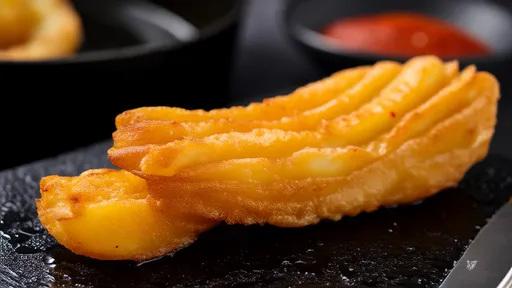
The culinary world thrives on precision, and nowhere is this more evident than in the meticulous preparation of ingredients. Among the many techniques that have gained popularity, the art of cutting potatoes into wavy, jagged slices—commonly known as "wolf tooth potatoes" or lang ya tudou—has become a staple in street food culture. The distinct texture and visual appeal of these potatoes rely heavily on the thickness of each slice, making the wave-cutting technique a critical factor in achieving the perfect bite.
At the heart of this technique lies the wave cutter, a specialized tool designed to create uniform, undulating slices. Unlike traditional straight-edge knives, the wave cutter produces ridges and valleys that not only enhance the potato's aesthetic but also influence its cooking behavior. The thickness of each slice determines how the potato absorbs heat, crisps up, or retains moisture. Too thin, and the slices may turn brittle or burn; too thick, and they risk becoming soggy or undercooked. Striking the right balance is an exercise in both art and science.
For professional chefs and street vendors alike, adhering to a standardized thickness ensures consistency in flavor and texture. The ideal thickness for wolf tooth potatoes typically ranges between 3 to 5 millimeters. This measurement allows the slices to maintain structural integrity during frying while achieving a satisfying crunch. Deviating from this range can lead to uneven cooking, with some pieces overcooking while others remain disappointingly limp. The wave cutter's blade must be sharp and well-maintained to guarantee clean cuts, as dull blades can crush the potato fibers, resulting in uneven surfaces and compromised texture.
Beyond the technical aspects, the wave-cutting technique also carries cultural significance. Originating from Sichuan cuisine, wolf tooth potatoes are often seasoned with bold, spicy flavors that cling to the ridges of each slice. The thickness of the cut directly impacts how much seasoning adheres to the surface, influencing the overall flavor profile. A slice that's too thin may become overwhelmed by spices, while a thicker cut might not absorb enough to deliver the characteristic punch. This interplay between cut and flavor underscores the importance of precision in what might otherwise seem like a simple street food snack.
Innovations in kitchen tools have further refined the wave-cutting process. Adjustable wave cutters now allow for customizable thickness, catering to regional preferences or specific culinary applications. Some vendors prefer slightly thicker cuts for a heartier bite, while others opt for thinner slices to maximize crispiness. The ability to fine-tune the cutter’s settings has elevated the humble wolf tooth potato from a casual snack to a customizable culinary experience, appealing to a broader audience.
Despite the availability of advanced tools, mastering the wave-cutting technique still requires practice and a keen eye. The angle at which the blade meets the potato, the pressure applied, and the speed of the cut all contribute to the final product. Seasoned chefs often develop a rhythm, producing perfectly uniform slices with effortless precision. For home cooks looking to replicate the magic, patience and attention to detail are key. Starting with a high-quality wave cutter and practicing on a few sacrificial potatoes can make all the difference.
The global rise of street food culture has brought wolf tooth potatoes to international attention, with food enthusiasts eager to recreate the dish at home. Social media platforms are flooded with tutorials on achieving the perfect wave cut, often emphasizing the importance of thickness. As this trend continues to grow, the wave cutter’s role in culinary precision becomes ever more apparent. Whether served spicy, sweet, or savory, the wolf tooth potato’s success hinges on that critical first step: the perfect cut.
Looking ahead, the wave-cutting technique may inspire further innovations in food preparation. As chefs experiment with different root vegetables or even fruits, the principles of thickness and texture remain universal. The wolf tooth potato’s journey from a regional specialty to a global phenomenon is a testament to the power of precision in cooking. For those who appreciate the craft, every slice tells a story—one of tradition, technique, and the relentless pursuit of perfection.

By /Aug 11, 2025
By /Aug 11, 2025

By /Aug 11, 2025

By /Aug 11, 2025
By /Aug 11, 2025

By /Aug 11, 2025

By /Aug 11, 2025
By /Aug 11, 2025
By /Aug 11, 2025

By /Aug 11, 2025
By /Aug 11, 2025

By /Aug 11, 2025

By /Aug 11, 2025

By /Aug 11, 2025

By /Aug 11, 2025

By /Aug 11, 2025
By /Aug 11, 2025

By /Aug 11, 2025
By /Aug 11, 2025

By /Aug 11, 2025
